Maker Business
Price Your Handmade Products Without Underselling Yourself
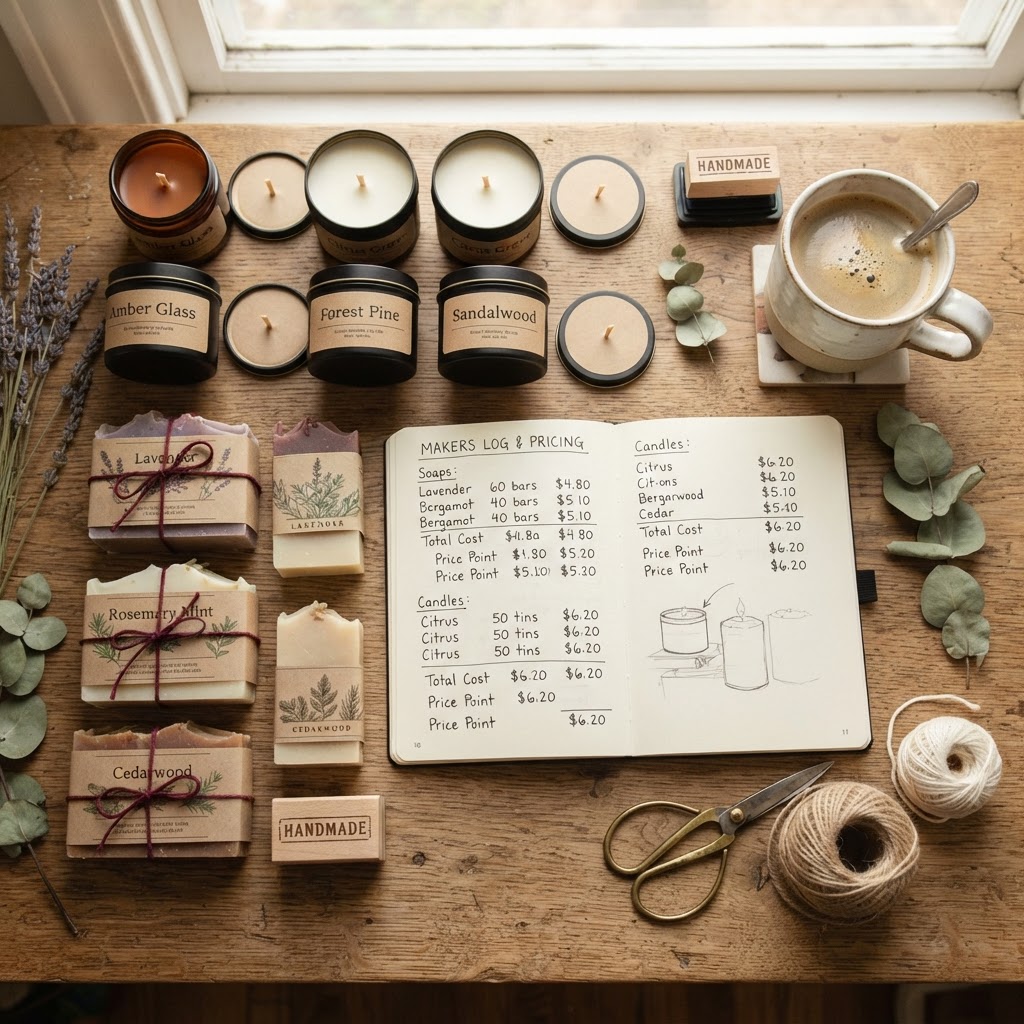
Most handmade makers price by guessing — and then wonder why they're exhausted and broke. Here's the actual formula that covers your costs, your time, and your future.
If there's one mistake we see new makers make over and over, it's this: pricing by feeling instead of by math. You look at a similar product on Etsy, see it selling for $8, and price yours at $8 — without ever calculating whether $8 covers your costs, your time, or your business's survival.
Let's fix that right now.
Why most handmade makers are underpricing
The handmade community has a pricing problem, and it's not hard to understand why:
- You see someone selling soap for $5 a bar and assume that's the market rate
- You feel guilty charging more because you're "just a small business"
- You're afraid no one will buy if you price what it's actually worth
- You don't know your actual costs because you haven't tracked them
Every one of these is understandable. Every one of them is keeping you broke.
The real cost of a bar of soap
Let's break down what it actually costs to make a single bar of cold-process soap — the kind you sell for $8.
Materials (per bar, rough estimate):
| Item | Cost | |---|---| | Oils (olive, coconut, castor) | $1.20 | | Lye | $0.15 | | Distilled water | $0.02 | | Fragrance oil (1 oz) | $1.50 | | Colorant/mica | $0.25 | | Total materials | $3.12 |
Overhead (per bar):
- Energy (stove, microwave): $0.10
- Packaging (label, box, wrap): $0.75
- Mold wear, tool depreciation: $0.05
- Total overhead: $0.90
Your time:
Let's say you make 20 bars in a batch that takes you 2 hours (prep, making, cleanup). That's 6 minutes per bar. If you value your time at $15/hour (and you should value it at more), that's $1.50 per bar in labor.
Total cost per bar: $5.52
If you sell that bar for $8, your gross profit is $2.48 per bar. Before fees, shipping supplies, marketing, and the time it takes to list, photograph, and ship it.
The formula that actually works
Here's the pricing formula we use and recommend:
Materials + Overhead + Labor = Total Cost Total Cost × 2 = Wholesale Price Wholesale Price × 2 = Retail Price
Using our soap example:
- Total Cost: $5.52
- Wholesale Price: $11.04
- Retail Price: $22.08
Yes. Twenty-two dollars for a bar of handmade soap. And if that number makes you uncomfortable, sit with that discomfort for a minute — because it's the reason you're exhausted.
Why the 2×2 formula
The first 2× covers your costs plus profit margin. The second 2× covers the business side: marketing, fees, taxes, insurance, equipment replacement, research and development, and the unpaid hours you spend on everything that isn't making product.
If you only double your cost once, you're covering materials and labor but not the business. You'll feel busy and broke. If you don't double at all, you're slowly going out of business while feeling productive.
But no one will pay that much
They will. But not everyone — and that's the point.
The person who buys soap for $5 at the craft fair is not your customer. Your customer is the person who wants handmade, clean ingredients, a beautiful product, and is willing to pay for the person who made it. Those people exist. There are more of them than you think. But they'll never find you if you're pricing for the craft fair crowd.
How to justify the price
You justify the price by being worth it:
- Clean ingredients. No phthalates, no parabens, no cheap fillers. Say so on your label and your listing.
- Beautiful packaging. A label that looks intentional, not printed on your home printer at 11 PM.
- Photography. Good photos don't cost money — they cost attention. Natural light, clean background, show the texture.
- Story. People buy from people. Tell them why you make this, what it means to you, why it's different from the factory-made version.
- Consistency. Every bar looks the same. Every batch is labeled. Every order ships on time.
The one thing to stop doing today
Stop looking at other makers' prices and using them as a benchmark. You don't know their costs, their margins, or whether they're actually making money. You know your costs. Price from there.
Your work is worth more than you're charging. Start acting like it.
♡
Keep learning with our e-books
Step-by-step guides for makers — soap recipes, body butter formulas, and more.
Browse E-Books & LearningJoin the Tribe ♡
Get new tutorials, recipes, and maker business tips straight to your inbox.
